
It’s a strange thing to live through our current times, isn’t it? I see the news and am reminded of events I had only previously read about in history books. For me, the world feels increasingly hard and terrifying, and sometimes just putting one foot in front of the other feels like a monumental task.
Know what I mean?
And so I find myself thinking more and more about Etty Hillesum.
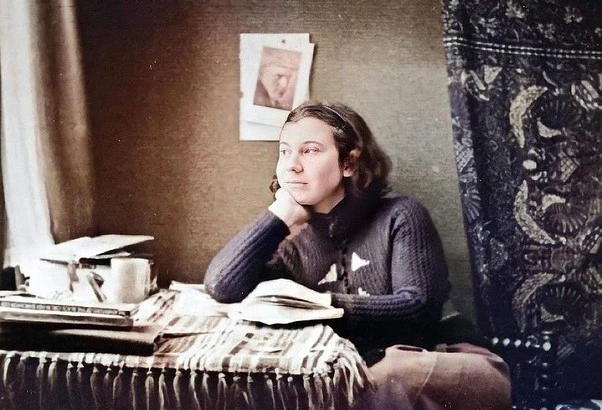
Born into the worst moment
Etty was a young Jewish woman living in Amsterdam at the start of the Second World War. As the Nazi occupation closed in around her, she began to write a diary. Not simply a record of the horrors outside — but the chronicle of a remarkable inner journey.
Her early entries show a woman full of turmoil, wrestling with depression and her own chaotic inner life. But instead of being consumed by the growing fear and hatred outside her window, she made a conscious choice to turn inward. "I really see no other solution", she wrote, "than to turn inwards and to root out all the rottenness there. I no longer believe that we can change anything in the world until we first change ourselves".
She began to find a deep, unshakeable connection to what she called God — not a God she petitioned for rescue, but a presence she felt had to be nurtured and protected within herself, no matter what was happening outside.
Walking towards the darkness
In 1942, Etty refused offers to go into hiding. Instead, she voluntarily went to work at Westerbork — a transit camp from which Dutch Jews were sent to their deaths in "the East". Why? She wanted, she said, to be what she called "the thinking heart of the barracks".
In a place designed to strip people of their humanity, Etty found love and moments of impossible joy. She wrote about the beauty of a jasmine flower, the sky, and the strength she found in a simple, quiet moment of prayer. She saw the suffering — she felt it acutely — but refused to let it extinguish her capacity to love.
"Despite all the suffering and injustice", she wrote, "I cannot hate others." She saw that her true power, the only freedom the Nazis couldn't take, was her ability to choose her response.
What she leaves us
Etty and her family were transported to Auschwitz in September 1943. She did not survive. But her diaries — passed to a friend before returning to the camp for the final time — did.
Her story isn't about ignoring pain or pretending everything is okay. It’s about something much harder and much more honest: accepting that we cannot always control what happens to us, but we can always — always — choose how we respond. We can meet hardship with hatred, or we can choose, as she did, to keep a small corner of the soul unsullied and answer with love.
Every difficulty is an invitation — not a guarantee, just an invitation — to discover something in ourselves that we didn't know was there.
Personally, I constantly fail to meet the standard that Etty set. I haven't gone deep in my spiritual relationship like she did, and so I haven't yet found the riches she did either — the ones that kept her strong in the darkest of times. I'm weak. But I know that is no reason to stop trying. I know that is no reason to give up. She set the standard, and if I can keep trying to meet it then surely that is worth something.
With hope, joy and love -
Hare Krishna and Namaste, I pray you have a blessed day.
What’s one small way you’re choosing love today — even when it’s hard?